
| Category | Joint Replacement Surgery |
Need of Surgery
Total knee replacement surgery is required when all the possible conservative measures for the treatment of knee OA are exhausted. Generally, by this time, all the compartments of the knee joint are affected and there might be bowing /deformity of knees present.
For patients, these are a few indicators that can help them decide when to undergo TKR –
Surgical Details
The objective of the surgery is to get a stable, well-aligned, pain-free knee.
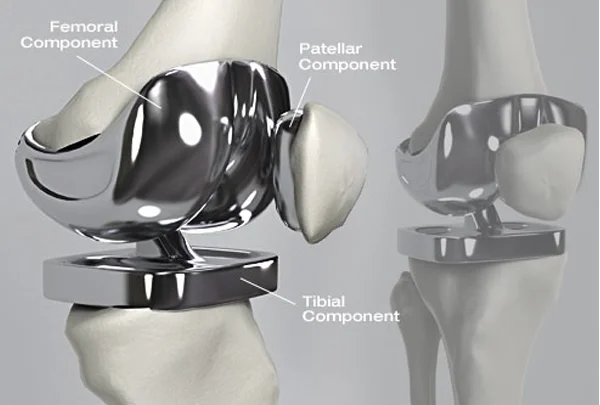
An Osteoarthritic knee has damaged cartilage, ligaments, menisci and a few loose bodies, osteophytes / extra bone, etc. During TKR, some amount of bone is shaved off from both the femur and tibia, along with the damaged cartilage, ligaments, and menisci. The amount of bone shaved off is customized as per every individual patient. The bony ends are then prepared and appropriately sized metallic implants are fixed to both the bones, along with a polyethylene insert.
There are a variety of metallic implants available in different sizes as per the requirement of the individual patients. Most commonly, Titanium and Cobalt-Chromium implants are used.
Post Operative Period and Rehabilitation
The patient is made to walk the day after the surgery using a walker. Knee bending and physiotherapy is also started the day after surgery. Generally, by post-op days 4-5, the patient is able to walk comfortably using a walker. They can be discharged thereafter. Stitch removal is done around 2 weeks after surgery. It is advisable to use a walker or a stick for at least 6 weeks after surgery.
Physiotherapy plays an important role during the post-operative period and often determines the success of the surgery. Patients are taught about its role and various exercises are advised to them as per their needs.


