
| Category | Joint Replacement Surgery |
About Osteoarthritis
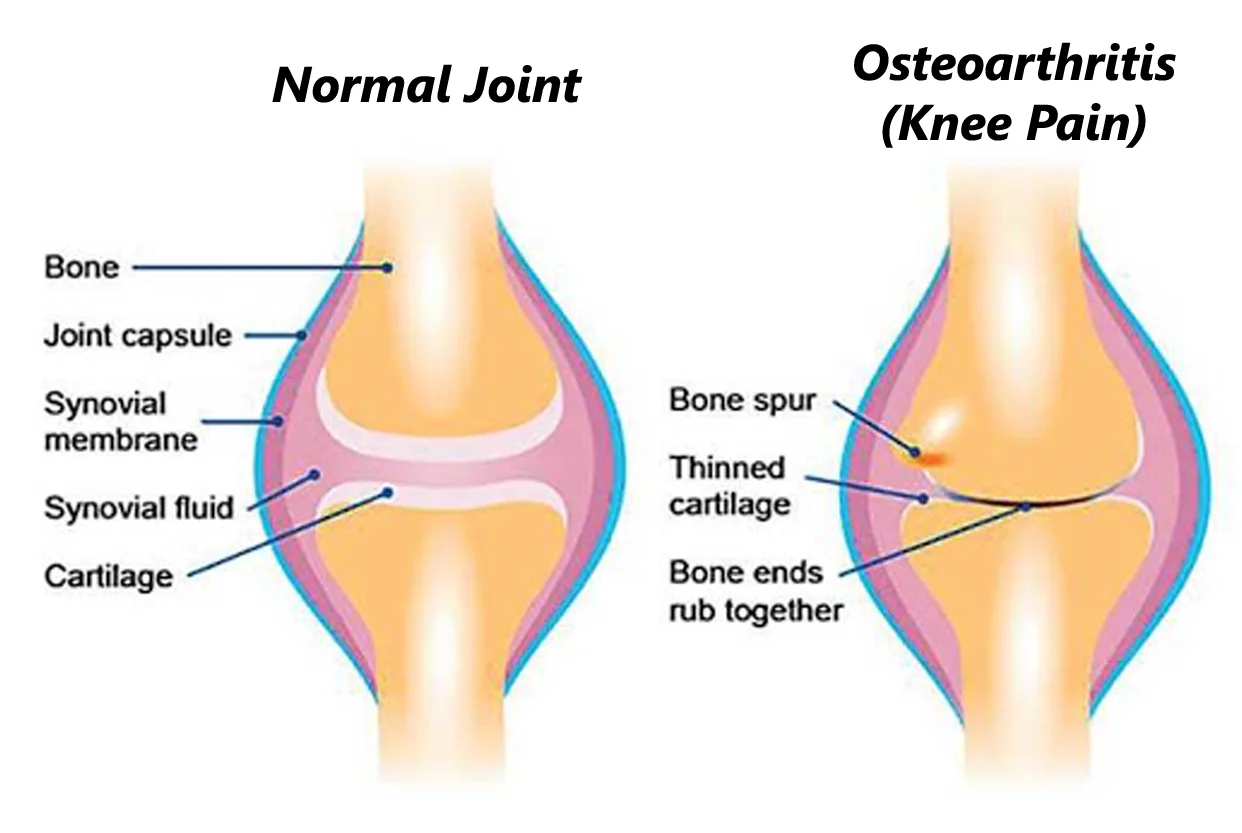
The ends of the bones constituting a joint are covered by a smooth lining of tissue, known as articular cartilage. Articular cartilage helps in smooth frictionless movement of joints and proper dissipation of forces across the joint. However, due to many causes, injuries occur in articular cartilage. Due to these changes, the smooth articular cartilage is damaged and degenerative changes in the form of small fissures/cracks start appearing. With continued weight-bearing, these changes keep accumulating and ultimately it leads to partial/complete thickness damage of the cartilage.
The reason why these changes start to appear are -
Symptoms
During the initial stages, the patient complains of occasional pain in the involved joint while completely bending knee/ hip ( while squatting/ using Indian toilets/ sitting cross-legged on the floor). This joint pain can become continuous during day and night time too with increasing severity. The patient even complains of pain in the calf and thighs.
With severe disease, the patient is unable to completely bend the involved joint. Joint deformity appears and the patient walks with a limp. Joint swelling also appears.
Diagnosis
Although clinical examination can help, an X-ray of the involved joint is needed. X-ray shows joint space narrowing with associated changes in surrounding bones. Deformity if present might also be visible. Early cartilage changes need an MRI scan as X-rays are normal in such cases.
Treatment
Mild to moderate osteoarthritis is managed by activity modifications. The patient is advised to avoid squatting, sitting cross-legged, and all those activities which provoke pain. Walking aids like a stick/walker can also be used to avoid weight bearing on the joint. Some special orthosis/braces are also available commercially to provide knee support, offload the knee partially. Analgesics are used to treat pain. Once the pain decreases, exercises are advised to restore muscle strength as muscular weakness sets in due to osteoarthritis. Various physiotherapy modalities are also used to decrease pain, improve muscle strength.
Some oral/Intraarticular supplements are also used. These supplements help in cartilage repair and prevent its damage.
Severe osteoarthritis (in which joint deformity has set in, and the daily activities of the patient are hampered due to OA) is resistant to the above-mentioned treatment for mild OA. It needs surgical treatment in the form of joint replacement.


